The Orgasm Gap Isn't Bad Luck. It's Bad Data.
“The female orgasm recession is men's most embarrassing metric.” I read that line last week in an Instagram post from Liz Plank of @feministabulous and I wish more people were talking about this.
I've written about the orgasm gap before, about how I used to fake it, and about how many women are stuck exactly where I was. But framing this as something men should be embarrassed about is a bold twist, and I'll admit it, I got a little excited reading it.
Before I go further, one quick note: I'm going to talk about men and women throughout this piece, and I want to name that gender exists on a much wider spectrum than that binary. The data I'm building this around comes from surveys of heterosexual men and women specifically, so for the sake of keeping the argument clear, that's who I'm referring to here.
Now, back to the gap.
The stat that started this
On her Substack, Liz followed that line with a stat: in one national survey, 85 percent of men reported that their partner had orgasmed the last time they had sex, while only 64 percent of women say they did. The discrepancy, as she put it, is almost touching in its optimism.
That stat landed hard, because I've lived inside it. I didn't have my first orgasm until I was 25, and even after that, it stayed wildly inconsistent with a partner. I thought I was the only one. Every woman I heard talk about sex seemed to be having a great time with it, so why was this so easy for everyone else and nearly impossible for me? I didn't know what I needed. I didn't know how to talk about it. And as a strong, confident, independent woman who was successful in basically every other area of my life, admitting that my intimate life wasn't working the way it was “supposed to” felt mortifying.
So I got good at something else instead. I learned to read a partner's arousal cues, and once he hit about an 8 out of 10, I'd put on a little performance and send him over the edge. If you've been in a long relationship, where you're over the honeymoon phase but are working to keep the spark alive, you probably know this move. There are moments you don't really want to keep going, you just want it to be over, and you find a graceful way to wrap it up.
Which is exactly why 85 percent of men believe their partner came last time, and only 64 percent of women say they actually did. We fake it. Constantly. And it's a problem, one that's unhealthy for both people in the room, because it doesn't just leave men with a false read on what works. It teaches women to keep abandoning their own bodies. Looking back, I can see the pattern clearly: every ounce of attention I spent tracking his experience was attention I wasn't spending on mine, and that's exactly how you end up disconnected, and not feeling much of anything at all.
Stop performing your pleasure
If this sounds familiar, I want to invite you to stop performing your pleasure. It isn't doing either of you any favors. You disconnect further from yourself every time you do it, and your partner walks away with false confidence in something that didn't actually happen. I've had more than one man tell me, with total sincerity, that every woman he's ever slept with has orgasmed every single time. Women reading this, raise your hand if you believe that. No. That's just not possible, sir. What about the girl you hooked up with in college, both of you drunk, five minutes, zero foreplay? That was not a real orgasm.
As the sex nerd I've become, I like to keep coming back to the data: only about 18 to 35 percent of women climax from intercourse alone. Most of us need, or are significantly helped by, clitoral stimulation to get there. Knowing that doesn't make it easy to trade a familiar pattern of faking it for something more honest. But it's a necessary, healthy step toward reclaiming pleasure that's actually yours. From there, the real question becomes yours to sit with: what is your experience, actually, and how do you stay connected to your own sensation while it's happening?
I believe both women and men have a role in closing this gap, and I'll get into that. But first, let's sit with the “embarrassing metric for men” framing a little longer.
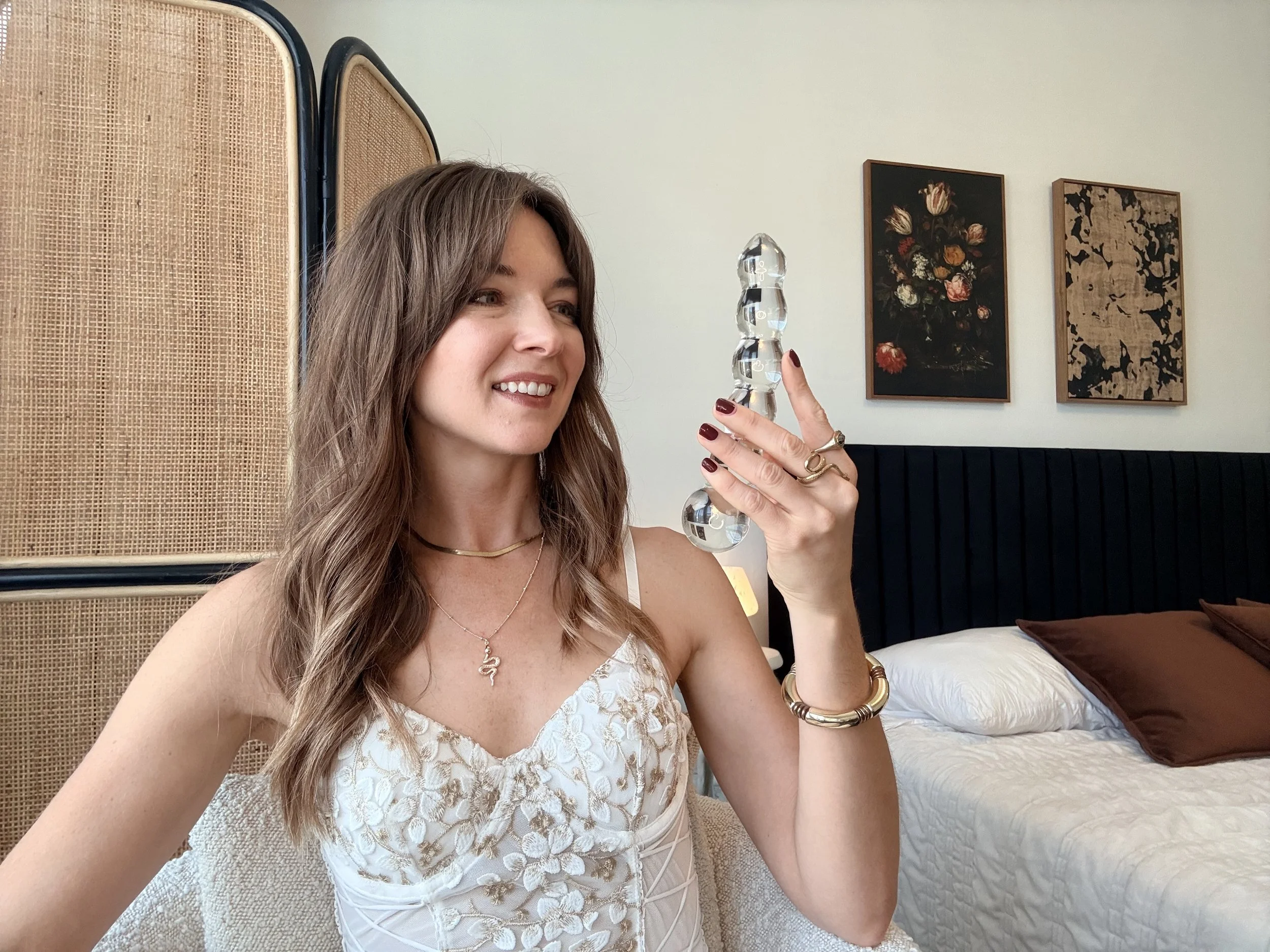
Delaney Matthews, certified women's sexual wellness coach and creator of Pleasure Ed
Why this is a culture problem, not a you problem
We built centuries of culture around women needing to marry for financial survival, and it wasn't that long ago. It wasn't until 1974, my mom's generation, that a woman could get a credit card without her husband co-signing for her. Before that, banks could legally turn her away on her own signature alone. A woman's survival was tied to her ability to secure and keep a husband, and that culturally shaped more than banking. It shaped what we were taught to prioritize in bed, and it still does.
I learned about sex as a teenager the way most of us did, from magazines that were somehow always about how to give a good blow job or how to dress for the male gaze. I bought two books hoping to fill the education gaps myself. I was too embarrassed to even leave them out, so I hid them and told myself I'd read them someday. One was The Joy of Sex, full of illustrated positions and almost no actual information about what makes sex feel good. The other was called Tickle His Pickle. I never finished either one, but I absorbed the thesis anyway: your job is to give him a good experience and be willing to try a lot of positions.
So I read that “embarrassing metric” line and I have to ask: did men grow up with magazines telling them how to dress for the female gaze? Books walking them through how to create a satisfying sexual experience for her? I doubt it. Why would they, when culture never made their survival depend on it?
That gap isn't just cultural, it's anatomical too. The clitoris has about 10,000 nerve endings, twice as many as the roughly 4,000 packed into a penis. By that math alone, the clit should be the main event of any sexual encounter, not the thing we call foreplay and rush past on the way to intercourse.
The script we were taught
For years I thought I was broken, like something was wrong with my body because I wasn't finishing with a partner. The more I've studied women's sexuality since, the clearer it's become: the issue was never me. None of us, women or men, were ever actually taught how pleasure works. Understanding what my own body needed to open was one project. Bringing that into a partnered experience was an entirely different one, especially when it required a partner to unlearn what he thought “good sex” meant, too.
Most of us were taught that sex is one continuous event that centers on intercourse and ends when he finishes, and that everything before that is just foreplay, a warm-up for the main event. When the main event doesn't deliver for her, she's left feeling like something is wrong with her, or used, or both. But that's the misconception, not her body. Only 18 to 35 percent of women climax from intercourse alone, and yet so many of us keep quietly trying to figure out how to get there anyway, without “needing” more clitoral stimulation, as if needing it were the failure. It isn't. It's just what her body actually requires.
What I hear from men and women
I'm not saying men are lazy or don't care. Most of the men I've talked to genuinely want to give pleasure and are doing their best with what they know. When I tell them that many women, myself included, spent years not knowing what they needed, I watch something click. That's exactly what they've experienced: they ask her what she wants, and she doesn't know either.
Most women I talk to are stuck somewhere similar, uncertain what it would even take, wondering if it's about technique or the right partner, or frustrated by a partner who isn't attuned to her body, or by too much pressure on the outcome and not enough time spent on the right kind of stimulation. I also hear women describe partners who create real emotional unsafety, and emotional safety is one of the biggest factors in whether a woman's body can relax enough to open at all. We don't talk enough about how much that matters when choosing who we let close.
So while I do think this is an embarrassing metric for men, I also think it's a shared project. Men can start by learning female anatomy and arousal, not as an afterthought but as the main subject. Come As You Are by Dr. Emily Nagoski and Becoming Cliterate by Laurie Mintz are both excellent places to start. If a book feels like too much right now, here's where I'd recommend putting some attention:
Closing the orgasm gap: 5 tips for men
Learn the clit. Not as an afterthought, as the main event. Most of what creates orgasm for a woman lives there, not inside penetration alone.
Build physical and emotional safety first. Her body won't fully open to pleasure if part of her is still on guard. Safety isn't foreplay, it's the foundation.
Be present, not just physically involved. Distracted attention is felt immediately, even wordlessly. Presence is the difference between touch and connection.
Remove the pressure for a particular outcome. The moment orgasm becomes the required finish line, she starts performing instead of feeling, and everyone loses.
Give her time to receive. Her body may need longer to fully arrive. Slow down, stay present, and let her receive without needing to perform, reciprocate, or hurry toward an ending.
And women, we have our own half of this. We can't expect a partner to know what we need if we don't know it ourselves. We grew up in a culture that either shames self-pleasure or reduces it to “just use a vibrator,” which doesn't always translate to a partnered experience anyway. The real work is learning your own body through mindful, unhurried exploration.
Closing the orgasm gap: 5 tips for women
Slow is not a warm-up. Slow is the main event. Arousal deepens the longer sensation builds, not the faster it escalates.
You can't guide a partner to something you haven't mapped yourself. Self-pleasure practice isn't optional, it's the data.
Learn to communicate honestly and directly about your needs, preferences, and desires. Vague feedback gets vague results.
Give yourself permission to take time. Practice receiving sensation and attention without needing to perform, reciprocate, or get somewhere quickly. Your body is allowed to take its time.
Orgasm is a learned response. If you've never had one, or only inconsistently, consider this your invitation to start learning your body's response pathways.
Start here
My free Practicing Pleasure Guide for women shows you where to start. It's a short, no-pressure way to start mapping your arousal through a conscious practice. You don't need to fix your body. And you aren't broken. You just need to start collecting your own data.
Frequently Asked Questions
What is the orgasm gap?
The orgasm gap is the difference in how often heterosexual men and women report orgasming during partnered sex. In one national survey, 85% of men believed their partner orgasmed the last time they had sex, while only 64% of women say they actually did.
Can women orgasm from intercourse alone?
Research suggests only about 18 to 35% of women reliably climax from intercourse alone. Most women need, or are significantly helped by, clitoral stimulation to reach orgasm.
Why do women fake orgasms?
Many women learn to read a partner's arousal cues and perform satisfaction rather than feel it, often to bring an encounter to a comfortable close or to protect a partner's confidence. Faking it reinforces disconnection from your own body over time.
How many nerve endings does the clitoris have?
The clitoris has roughly 10,000 nerve endings, about twice the roughly 4,000 in a penis, which is one reason clitoral stimulation matters as much as it does for female orgasm.
What can partners do to help close the orgasm gap?
Learning the clitoris as the main event rather than an afterthought, building physical and emotional safety first, staying present, removing pressure around a specific outcome, and giving her time to receive are five concrete places to start.